
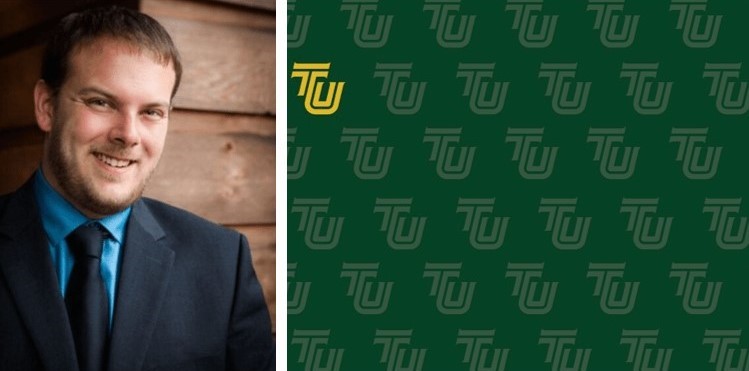
Current occupation: Senior Sales Engineer at HiBob, Adjunct Professor at Defiance College and Savannah State University
What made you decide to pursue your degree as an adult?
As I got into my career, I became passionate about modernizing HR, and I realized that companies are moving much more quickly than academia. I felt it was a good opportunity to integrate my life passions (research and HR) to help further evangelize the outcomes that People First HR Model can bring to an organization and its employees.
Why did you choose to study at Tiffin University?
The program is about helping organizations with change. Tiffin University recognizes that change and transformation is constant. It’s evident that TU itself is committed to creating a unique culture that promotes embracing change and agility. This is not always the case in higher education, and I knew that if I wanted to be educated by the best, I needed to go to a university that practices what it preaches. It’s not just PR. TU does it, and the faculty, staff, and students do it very well. Everything, from the curriculum to the faculty, as well as TU’s diversity philosophy, checked all of my boxes, so it was a no-brainer.
Describe your experience with the program so far.
The program engages us by giving the right kind of challenges, and these challenges are very manageable. During my first conversation with Dr. Rauch, he said that obtaining a Ph.D. was very realistic and something that I’d enjoy, but I was skeptical. I was shocked at how wrong I was. Tiffin focuses on student enablement, so navigating the technology, working with the library, etc. was very easy. This allowed for me to focus on the actual rigors of the program instead of dealing with the distractions of navigating the university itself. Top that with the frequency of transparency and communication from the program leaders and instructors, and I couldn’t have asked for anything better.
How has your experience been with your cohort and faculty?
The fact that the faculty goes above and beyond what is expected is what has truly made me feel comfortable. Each faculty member in the program has interesting perspectives and they are committed to making us better. We have had weekly discussions with faculty members in some of more complex courses, such as quantitative statistics. I’ve also have had other professors who provide very detailed feedback on my writing and it’s always great to reflect on how much I have developed as a writer with the feedback I have been given.
How are you juggling work, life and going back to school? Any tips?
I’m in a unique situation. My fiancée is a nursing student so his program is also very rigorous. However, we both enjoy learning, so it never feels like it is much of a chore. He and I are known to take our iPads and laptops with us to our local hangouts on date nights to study together, and we proofread each other’s work and run things by each other when we are stuck. So, in addition to knowing more about my field of interest, I also get to learn things about hemochromatosis when I’m helping my fiancée study, which is a bonus! Our two kids, employers, and extended family are also wildly supportive. I can’t say it’s always easy, but I feel very lucky to have such a big network that supports a healthy integration of my work, education, and personal life.
What keeps you motivated to stay in the program?
I’m neurodivergent. I think and act very differently and when I was in secondary school, it made the social aspect tough, and the learning even tougher. I never thought that I’d go to college, let alone get a doctorate simply because my first experience in an educational setting was so hard. However, I learned that academia is very much different and appreciative of all the things that made me an outcast in the first place. I learned that a change of setting was exactly what I needed to focus more on learning the way that worked for me. One of the biggest things my parents taught me through all of this was, whether I am naturally good at something, or terrible at it, just start somewhere and don’t quit until the job is finished, and that is a lesson I wish that every neurodivergent person had been taught. So, for me, it’s for all of the very capable neurodivergent people before me who gave up their dreams simply because of what they may have been told, or how they may have felt as youngsters.
What advice would you give to a prospective student who is thinking about going back to school?
You deserve your education. Don’t sit and wait for the perfect time to go after it. That perfect time simply won’t come. You just have to jump off into the deep end and be very regimented as you integrate the education into your life. You’ll certainly be busy, but you won’t be sorry!
TU’s motto is: Without risk there is no gain. Can you tell us about a time when you took a risk and what you gained from it?
I had a job that I absolutely loved, but I felt stagnant, and I wasn’t learning at the pace that I wanted. As a result, I decided to leave the comforts of that job and move to where I am now. I was so scared that I was making a mistake, but I realized that I went to this job to learn, and let me tell you, I am learning from so many amazing colleagues. It’s giving my brain the exercise that it was craving, and I have been having so much fun as my company seeks to change the way that Human Resources is done throughout the world.