
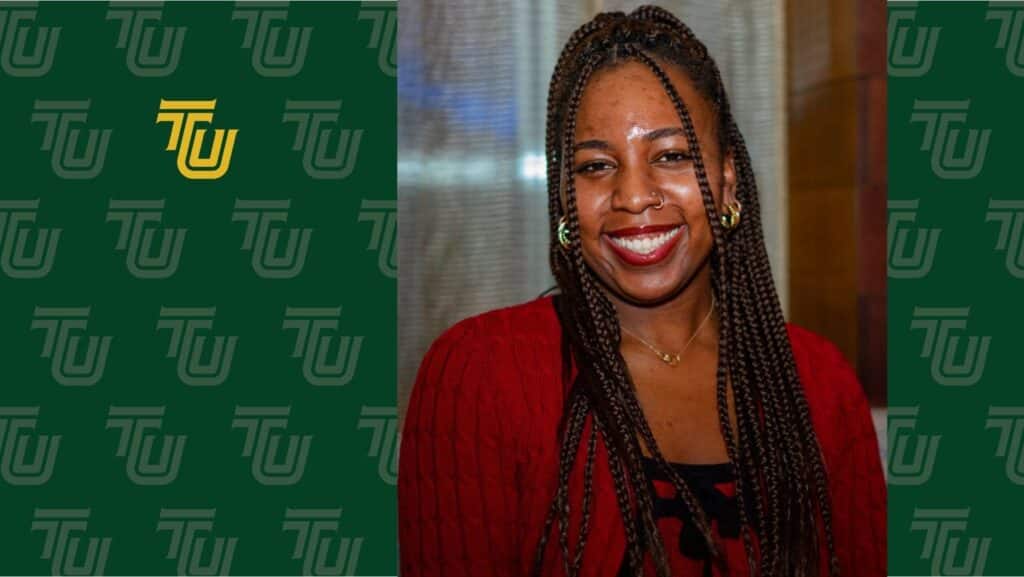
Since we first featured Imani Moore, an MBA in Sports Management and MBA in International Business student in Tiffin University’s partnership program with the American Institute of Applied Sciences in Switzerland, her journey has continued to gain momentum in remarkable ways. Most recently, Imani secured a six-month paid internship with the World Baseball Softball Confederation in Switzerland, where she is working within the Presidential Cabinet on projects tied to major international sporting events and global sport governance.
In this follow-up spotlight, Imani reflects on how the opportunity came together, what she is learning through her work with the WBSC and how her TU experience has helped prepare her for this next step. She also shares what this milestone means to her personally and professionally, along with insight for other students who hope to pursue international opportunities in sports management.
You recently secured a six-month paid internship with the World Baseball Softball Confederation in Switzerland. How did that opportunity come about?
In October 2025, Dr. Bonnie Tiell, Dr. Liston Bochette, and Margriet de Schutter visited the American Institute of Applied Sciences to host a Sport Career Workshop, which included a field trip to the Olympic Studies Center and the headquarters of the International Bobsled & Skeleton Federation (IBSF). During a conversation with the IBSF President, Dr. Tiell mentioned that I was seeking an internship or mentorship opportunity as a graduation requirement, and he kindly directed me to the Federation’s Head of Communications.
In my conversation with her, I shared my background in softball and my long-term career aspirations. She then mentioned that the World Baseball Softball Confederation (WBSC) was looking for an intern in the President’s office and asked whether that might interest me — it absolutely did. After several weeks of correspondence, I was offered an interview with the Chief Operations Officer. I was subsequently invited back for a second interview with the full leadership team including the President, Executive Director, Chief Operations Officer, and the President’s Assistant — who collectively offered me the position on the spot.
What division are you working with at the WBSC, and what is the main focus of that team?
I am working in the Protocol and Special Projects department which focuses on World Games such as but not limited to the Olympic Games, Youth Olympic Games, Mediterranean Games, and more. They also focus on relations with the IOC, other Members of the Olympic Family, and international organizations, as well as strategic planning.
What are some of your key responsibilities from day to day in the role?
In my role as an intern within the Presidential Cabinet at WBSC, my responsibilities span three core areas. First, I support the coordination of major multi-sport events including but not limited to the 2026 Gymnasiade, Youth Olympic Games in Dakar, and Mediterranean Games in Taranto by tracking project timelines, maintaining documentation, and ensuring deadlines are met.
Second, I handle interdepartmental coordination by liaising with colleagues across departments, monitoring the Olympic Movement landscape for strategic opportunities, and maintaining project tracking through Monday.com.
Third, I provide administrative and logistical support, including drafting official communications, preparing meeting minutes, and assisting with travel arrangements.
How does this internship experience connect to your MBA in Sports Management at TU?
My MBA in Sports Management at TU and my International Business Administration degree have complemented each other in ways that this internship has really brought to the surface.
The strategy and governance coursework gave me a strong conceptual understanding of how international sports organizations are structured and how decisions are made at the highest levels. Being embedded in the Presidential Cabinet at WBSC has let me see that from the inside by contributing to projects like the 2026 Youth Olympic Games and Mediterranean Games, and observing how an International Federation navigates relationships with the IOC, LOCs, and other key stakeholders. That connection between theory and reality has been one of the most rewarding parts of this experience.
The leadership and management modules from my MBA also prepared me to work across teams, manage multiple priorities, and communicate effectively in a professional environment. Here, I’ve had to do exactly that — coordinating between departments, maintaining project tracking, drafting official correspondence — all while supporting a senior leadership team with real deadlines and real consequences.
What has also struck me is how deeply international this role is in practice. Every project I work on spans multiple countries and cultures — from Dakar to Taranto to Merida — and the stakeholders I interact with bring very different communication styles, expectations, and contexts. My MBA’s global focus prepared me to navigate that complexity with awareness and adaptability, but experiencing it firsthand has given me a much richer appreciation for what working in international sports truly demands.
Ultimately, this internship hasn’t just complemented my MBA — it’s reinforced why I chose this path and where I want to take it.
You are the first TU student to be accepted by an international federation. What does that milestone mean to you personally and professionally?
Wow! I didn’t know that.
Personally, I feel that this is an insane experience. I’ve really had to slow down and take a minute to look at my circumstances and how I got here; it inspires me to keep looking up and onward. Nothing I’ve done in the last two years has been anything I could’ve ever imagined for myself. So it’s reminding me to keep my options open and trust myself, something I did two years ago that has completely changed my life.
Professionally, it has always been a goal to make the sport of softball more accessible, which is something I have the opportunity to do here so this is a really special and personal internship for me, I feel grateful to be here, but I know this is not nearly my last stop.
What skills or strengths are you developing in this internship that you believe will help you in your future career in sports management?
This internship has placed me inside a truly global organization, and that environment alone has been one of the most valuable parts of the experience. Working alongside colleagues from different countries and cultural backgrounds — many of whom operate in English as a second or third language — has sharpened how I communicate. I’ve become more intentional, more precise, and more aware of how tone and word choice land differently depending on who’s in the room.
On a practical level, I’m building real administrative and operational fluency — managing executive calendars, drafting formal correspondence, supporting projects tied to major international competitions. These aren’t abstract skills. In sports management, the ability to coordinate across time zones, communicate with diverse stakeholders, and keep complex logistics moving is foundational, and I’m getting direct exposure to all of it.
What I’m most developing, though, is perspective. Understanding how a global sports governing body actually functions — the decisions, the structure, the pace — is giving me a framework I’ll carry into every role after this. I’m not just learning tasks; I’m learning how international sport is organized at the highest level, and that context will set me apart.
How has living and studying in Switzerland influenced the way you see the global sports industry?
Living in Switzerland has completely changed the way I see the global sports industry. I think being an American can be such a pigeon hole experience. Before I came here, outside of the IOC, global sport was not on my mind and I was not fully aware of everything that goes into global sport such as geopolitics, National Federations and National Olympic Committees and the things they do, etc. I now have a well-rounded view of how these things are managed and how they operate. It is a completely different beast than the sports industry at home and it’s also been interesting to learn how Federations like the WBSC work in tandem with different leagues, both private (MLB for example) and public.
When you look ahead to your next steps after graduation, how do you see this WBSC internship shaping your goals or plans?
Honestly, this internship feels like the piece that ties everything together. I played softball in college, I’ve spent years caring about growing the game globally, and now I’m sitting inside the organization that actually makes that happen at the highest level — working directly out of the Presidential Cabinet on events like the Youth Olympics and Mediterranean Games.
My goal after graduation is to attend UCLA Law and pursue their Sport and Entertainment specialization, which has always felt like the right next step — it’s home, it’s one of the best programs in the country, and it makes sense financially too. But beyond logistics, I want to walk into that program with real experience in international sports governance, not just theory. Between my background in international business and my MBA in sports management, this role is the bridge that connects all of it and allows me to gain real world experience in the career I’ve chosen for myself.
What advice would you give other TU MBA Sports Management students who are interested in similar opportunities?
My advice would be simple: know who you are, know where you’re going, show up to everything, and be yourself.
When I was choosing my Master’s program, I was torn between international business administration and sports management. International business felt almost too broad — the possibilities were so vast that it was overwhelming to picture what I’d actually do with the degree. Sports management was the opposite problem: a focused, exciting path that could potentially box me in later in life.
So my goal became finding a program that genuinely fit me and because I know myself, I know I can get bored and want to pivot. I needed something that gave 20-something Imani the freedom to explore, while also protecting 40-something Imani — the version of me who may have discovered an entirely new direction but wouldn’t have to go back to school to pursue it, because her degrees already covered her core interests.
If I hadn’t known that about myself, I wouldn’t have made the choices I did and I wouldn’t be in any of the positions I’m in today. Know yourself, trust yourself and consider your future self in all of your decisions, big or small.