
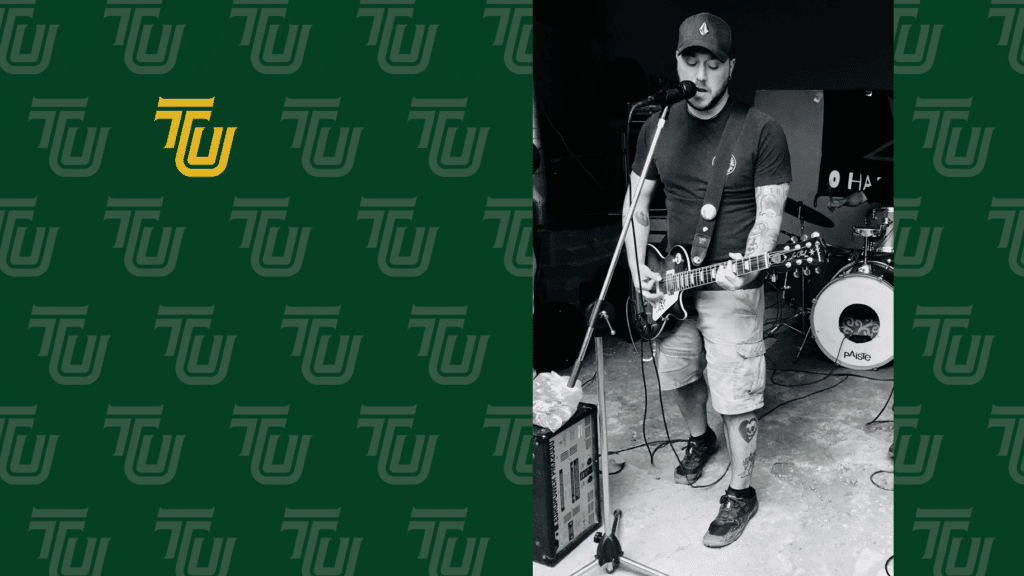
Current occupation: Associate Professor at Tiffin University
What made you decide to pursue your degree as an adult?
I’ve always had in interest in both literature and art, especially music and film. I had been working on multiple writing projects, and my wife suggested that I continue my education. As a middle/high school teacher, education was, and still is, something that’s important to me.
Why did you choose to study at Tiffin University?
I chose Tiffin because of the ability to complete my degree online. It is difficult to work full-time and attend classes, but Tiffin offered a degree that would allow me to pursue multiple goals at the same time.
Describe your experience with the program, your cohort and faculty?
My primary concern was the time commitment a master’s degree would require. I was managing a restaurant and working 60-70 hours per week. While I did struggle sometimes, the technology used for online courses, especially from the student perspective, was relatively self-explanatory. It allowed me to schedule my time and work at my own pace throughout the week.
Most of my interactions with my cohort were through message boards; however, in a few of my classes were were put into writing groups. I was very happy with a lot of the feedback I was able to get on my writing, but also to gain more perspective based on what my classmates were writing. It was interesting to see how diverse our skills and interests were. My interaction with the faculty was always top notch. Being online, most of my communication with them was via email, but they were always prompt and willing to help when it was needed.
How did you juggle work, life, and going back to school? Any tips?
It’s not easy. That’s the simple answer. Like I said, I was working a more-than-full-time job, and my wife was also working full-time and completing her own master’s at the same time, so we both knew that we had to reserve time to complete assignments, read, write, etc. For me, it was all about priorities. While my family and my job had to come first, school sometimes had to take priority over hobbies. I set up a couple days a week that were reserved for assignments and nothing else. This helped to get the bulk of the work out of the way each week while leaving time for working out, playing guitar, and hanging out with my wife. There’s definitely an element of sacrifice to completing a challenging program, but I knew that when I started. If it was easy, it wouldn’t feel like an accomplishment.
What kept you motivated to stay in the program?
In all honesty, I think it was a sense of accomplishment. I started the program and never wanted to leave it unfinished. If anything, finishing the program has only made me want to continue learning more about literature and writing.
What advice would you give to a prospective student who is thinking about going back to school?
It’s never too late. My whole college “career” has been less than ideal. I changed majors a few times during my bachelor’s, but finally found my interests when I was in my mid-twenties. I didn’t enter my master’s program until I was 36. If someone is thinking about going back to school, I say go for it. There’s really nothing to lose, but there’s so much to gain… even if it’s just a better understanding of yourself and the world around you.
TU’s motto is: Without risk there is no gain. Can you tell us about a time when you took a risk and what you gained from it?
After I graduated with my bachelor’s, I was offered a position teaching English overseas. It wasn’t something I’d ever thought about, and it was a chance that fell into my lap. That experience led to another and then another. Taking those chances has led to some of the most challenging experiences in my life, but also led to some of my favorite memories and life lessons. It’s the reason I can speak two languages, and the reason I met my wife. I honestly believe that the risks we take are what make use who we are.